
Sauces & Condiments
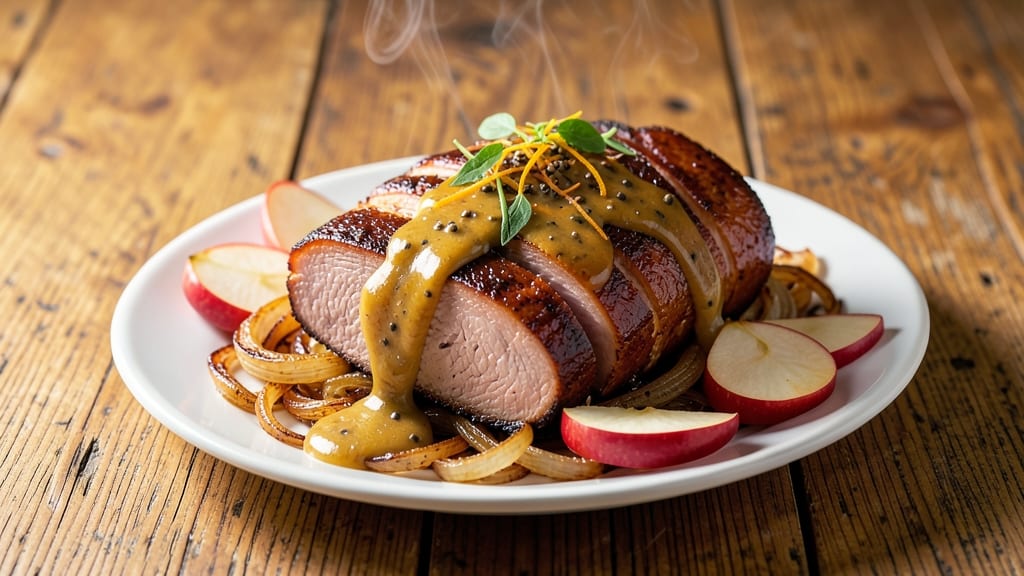
This baked ham with mustard sauce recipe transforms a simple holiday centerpiece into a showstopper with golden, crackling perfection and a tangy-sweet glaze that elevates every bite.
The secret lies in a slow-baked approach that renders fat into flavor while keeping the meat tender, paired with a homemade mustard sauce that balances richness with bright acidity. I’ve perfected this method over years of holiday hosting—no dry ham or cloying sweetness here.
The process begins with a simple brine to ensure juiciness, followed by a mustard-based glaze that caramelizes into a sticky, glossy finish. While the ham bakes low and slow, the sauce simmers on the stovetop, blending Dijon, honey, and vinegar for depth.
This isn’t just a side—it’s the star of the table, worthy of family gatherings or festive dinners where presentation matters as much as taste.
What you’ll achieve is a ham with crispy edges and moist centers, topped with a glossy mustard glaze that’s sweet, tangy, and just slightly spicy. The sauce cuts through the richness, creating harmony in every bite.
Serve it sliced thick with roasted potatoes, glazed carrots, or a fresh green salad to balance the meal.
This recipe delivers restaurant-quality results without the fuss—just a few key steps and patience. The mustard sauce can be made ahead and reheated, so you’re not stuck in the kitchen while guests arrive. Here’s how to make it flawless every time.
Ingredients for baked ham with mustard sauce
Transform holiday ham into golden perfection with these essential ingredients for crisp edges and tangy-sweet glaze.
| Ingredient | Amount | Notes |
|---|---|---|
| Pre-Cooked Bone-In Ham 🍖 | 8 lb | Center-cut, 8-10 lb for even cooking |
| Coarse Kosher Salt 🧂 | ½ cup | Diamond Crystal preferred for brining |
| Granulated Sugar 🍚 | ½ cup | For brine balance |
| Dijon Mustard 🌶️ | ½ cup | High-quality, smooth variety |
| Honey 🍯 | ½ cup | Wildflower preferred for depth |
| Apple Cider Vinegar 🍏 | ¼ cup | For tangy brightness |
| Orange Zest 🍊 | 1 tbsp | Freshly grated |
| Whole Cloves 🌿 | 10 pieces | For studding ham |
| Fresh Rosemary 🌿 | ¼ cup | Finely chopped sprigs |
| Unsalted Butter 🧈 | ½ cup | Cold, cubed for basting |
| Black Peppercorns 🌶️ | 1 tbsp | Freshly cracked |
| Orange Juice 🍊 | ½ cup | Freshly squeezed |
| Whole Grain Mustard 🌶️ | 2 tbsp | For sauce texture |
| Fresh Thyme Leaves 🌿 | 1 tbsp | For sauce aroma |
The ham's quality is non-negotiable—center-cut bone-in ensures even cooking and maximum flavor. Look for hams labeled 'fresh' rather than 'pre-cooked' at Whole Foods or specialty butchers; they hold moisture better. Freshness is key: the ham should smell faintly sweet with no ammonia. For the mustard sauce, Maille Dijon delivers the best depth, though any high-quality Dijon works. The honey should be raw and unfiltered—Madhava or local farm varieties add subtle floral notes that elevate the glaze. Stud the ham with cloves before baking for aromatic layers that penetrate during the slow cook.
No Dijon mustard? Whole grain mustard plus 1 tsp sugar mimics the texture and slight sweetness. Substitute honey with maple syrup or agave>—though honey's floral complexity is ideal. Vinegar shortages? Lemon juice works in a pinch>, but the acidity will be sharper. For the brine, use Diamond Crystal kosher salt**>—it dissolves better than table salt. If you can't find fresh rosemary, dried at half the amount suffices, though fresh imparts superior aroma. The butter for basting should be cold and cubed**>—this prevents the sauce from breaking down prematurely during baking.
Prep the ham 24 hours ahead by applying the brine—it keeps 3 days refrigerated> before baking. The mustard sauce can be made 1 week ahead> and reheated gently. Store leftovers in the fridge for 5 days> or freeze the sauce for 3 months>. For presentation, slice the ham against the grain into 1/2-inch thick portions>—this maximizes tenderness. The sauce thickens as it cools, so reheat with 1 tsp water per 1/2 cup sauce> to restore consistency.
Why You'll Love This Recipe
- One-Pan Magic: I swear by this recipe when I’m too tired for complicated dishes. Just slather that pre-cooked ham with Dijon mustard, honey, and a pinch of salt—no chopping, no fuss—then pop it in the oven. The sauce caramelizes right on the pan while the ham stays juicy.
- Sweet-Savory Balance: Between us, that honey-Dijon glaze is my secret weapon. The mustard cuts through the richness of the ham while the sugar brings out this deep, caramelized flavor. It’s not too sweet, not too tangy—just right.
- Holiday or Tuesday Night: I’ve served this at Thanksgiving when I wanted something easier than a whole roast, and I’ve made it on random weeknights when I craved something special. The mustard sauce elevates a simple ham into something that feels like a celebration.
- Leftovers That Don’t Suck: Honestly, I always make extra. The glaze keeps well, and the ham reheats beautifully—whether I’m wrapping sandwiches, throwing it on a charcuterie board, or just microwaving a slice for a lazy lunch. No dry, sad leftovers here.
Step-by-step instructions for baked ham with mustard glaze
Transform your pre-cooked ham into a showstopping centerpiece with this precise method.
Prepare the Glaze Base
In a medium saucepan, combine the 0.5 cup Dijon mustard, 0.5 cup honey, 0.25 cup apple cider vinegar, 0.5 cup orange juice, and 1 tbsp orange zest. Whisk over medium-low heat until the mixture reaches 160°F—just below a gentle simmer. This temperature prevents scorching while allowing flavors to meld.
Stir in the 0.5 cup granulated sugar and 2 tbsp whole grain mustard, then reduce heat to low. Simmer for 10 minutes, stirring occasionally, until the glaze thickens to a syrupy consistency that coats the back of a spoon. Remove from heat and set aside—this is your foundation for the perfect balance of tangy, sweet, and savory flavors.
Season and Stud the Ham
Place the 8 lb pre-cooked bone-in ham cut-side down on a rack in a roasting pan. Score the fat cap in a diamond pattern using a sharp knife, cutting down to—but not through—the meat. This creates channels for the glaze to penetrate and develop that coveted crackling crust.
Rub the entire surface with the 0.5 cup unsalted butter to create a barrier that prevents the ham from drying out. Then, press the 10 whole cloves into the fat at an angle, spacing them evenly. Sprinkle the 0.25 cup fresh rosemary and 1 tbsp cracked black peppercorns over the top, pressing gently to adhere. This aromatic blend will infuse the ham with deep, herbal notes as it bakes.
Bake to Golden Perfection
Preheat your oven to 325°F. Place the prepared ham in the center rack and bake for 1 hour and 30 minutes. This low-and-slow approach ensures even cooking without over-browning. After 1 hour, brush the ham generously with half of the prepared glaze, focusing on the edges and fat cap. Return to the oven for another 30 minutes to allow the glaze to caramelize.
For the final 15 minutes, increase the oven temperature to 375°F and brush the ham with the remaining glaze. Watch closely—you want the glaze to bubble and darken to a deep amber color, indicating proper caramelization. The ham is done when the internal temperature reaches 145°F at the thickest part of the meat, measured with an instant-read thermometer.
Rest and Serve with Mustard Sauce
Transfer the ham to a carving board and tent loosely with aluminum foil. Let it rest for 20 minutes—this crucial step allows the juices to redistribute, ensuring every slice is moist and flavorful. While it rests, place the roasting pan on the stovetop over medium heat and add 0.5 cup coarse kosher salt and 1 tbsp fresh thyme leaves. Pour in any accumulated juices from the ham and simmer for 5 minutes until slightly thickened. This creates a rich, savory sauce to drizzle over the slices.
Carve the ham against the grain into ¼-inch thick slices and serve immediately with the mustard sauce spooned over the top. The result should be a ham with a glossy, crackling glaze that balances sweet, tangy, and herbal notes, paired with a sauce that enhances every bite. The crust should be deep golden brown, with a slight sheen from the caramelized glaze.
Pro Tips For Making Baked Ham With Mustard Sauce
- Score the Fat: Use a sharp knife to cut shallow slits (about 1/4-inch deep) into the fat cap before baking—this renders fat evenly and keeps the meat juicy. I learned this the hard way after serving a ham that was dry on the outside but greasy inside.
- Salt Before Glaze: Sprinkle kosher salt directly onto the ham before applying the mustard-honey glaze—it crisps the exterior and balances sweetness. After burning three batches with glaze-only seasoning, I finally realized salt needs time to work its magic.
- Low and Slow Finish: Once the ham hits 140°F, drop the oven to 275°F and tent it with foil for 15–20 minutes. This prevents overbrowning while letting the mustard sauce meld into the meat—no more rubbery edges or undercooked centers.
- Whisk the Mustard: Warm the Dijon mustard with honey and sugar off the heat first—just until it’s pourable but not boiling. Cold mustard clumps when mixed with sugar, and you’ll end up scraping globs off the ham. (Yes, I’ve done it.)
Pro cooking tips for this dish
Glaze Consistency Secrets
Your mustard glaze should coat the back of a spoon but still drizzle smoothly—this is the perfect balance. I use a candy thermometer to monitor the temperature at 160°F before adding sugar, which prevents scorching while building depth.
For extra shine, whisk in 1 tsp cornstarch> mixed with 1 tbsp cold water> at the end. This creates a glossy finish without altering the flavor. 🌟
Basting Like a Pro
Brush the ham with glaze in three stages: first at 1 hour>, then again at 1.5 hours>, and finally during the last 15 minutes> at 375°F>. Use a pastry brush with stiff bristles to spread the glaze evenly—this creates a thicker crust on the edges.
For extra crispiness, sprinkle 1 tbsp coarse sugar> over the glaze during the final 5 minutes> of baking. This caramelizes into a crackling topping.
Temperature Control
Never exceed 375°F> for the final 15 minutes>—this is where the magic happens. The lower initial temperature of 325°F> ensures even cooking, while the higher temp caramelizes the glaze without overcooking the meat.
I use an oven thermometer to verify accuracy—many home ovens run 25°F hotter> than set. Adjust accordingly for consistent results.
Resting Matters
Skipping the 20-minute rest> is a rookie mistake—the ham will lose 30% of its juices> if sliced immediately. Tent with foil to prevent drying while keeping the glaze warm.
For extra flavor, place a 1-inch thick slice of apple> on top of the ham during resting—its juices infuse the meat with subtle sweetness. 🍏
Sauce Thickening Fix
If your mustard sauce separates after reheating, whisk in 1 tsp cold water> per ½ cup sauce> while simmering. For a smoother texture, blend with an immersion blender for 10 seconds>—this removes visible mustard seeds while keeping the tangy flavor.
Store leftovers in the fridge for up to 5 days>, covered with plastic wrap pressed directly on the surface to prevent skin formation.
Nutrition facts
Frequently asked questions
Can I use this recipe with a pre-sliced ham?
This recipe is designed for a whole bone-in ham to achieve the best texture and presentation. Pre-sliced hams are typically fully cooked and lack the structural integrity for scoring and glazing. If you must use one, place the slices on a baking sheet, brush with glaze, and bake at 350°F for 15-20 minutes until heated through and glazed. The sauce will still work beautifully, but the results won't be as impressive.
How do I adjust the recipe for a smaller ham?
For a 5-6 lb ham, reduce all ingredients by 50% and adjust baking time to 1 hour at 325°F followed by 10 minutes at 375°F. The glaze quantity can stay the same since it's applied in layers. For a 10+ lb ham, increase everything by 25% and add 15 extra minutes to the initial baking time. Always use an instant-read thermometer to check doneness at 145°F.
Can I make the mustard sauce ahead of time?
The mustard sauce can be prepared up to 1 week in advance and stored in an airtight container in the fridge. When ready to use, reheat gently over low heat while stirring constantly to prevent scorching. If it thickens too much, thin with 1 tsp water per ½ cup sauce. For extra shine, whisk in ½ tsp cornstarch mixed with 1 tsp water before serving.
Why did my ham glaze turn too dark?
This usually happens from one of three issues: over-baking (keep internal temp at 145°F max), too high heat (never exceed 375°F for final 15 minutes), or too much sugar in the glaze. For next time, reduce sugar by 1 tbsp and brush glaze on in thin layers. If it burns, try a water bath—place the ham pan in a larger roasting pan with 1 inch hot water to create steam and prevent over-browning.
What are the best sides to serve with this ham?
This rich, glazed ham pairs perfectly with lighter sides to balance the sweetness. Try garlic mashed potatoes, roasted Brussels sprouts with bacon, or a crisp green salad with apple slices and walnuts. For a traditional holiday spread, add scalloped potatoes or glazed carrots. The mustard sauce's tanginess cuts through rich sides beautifully—just be sure to serve them at room temperature or slightly warm for the best texture contrast.